
Context Definition anchors decisions, interpretation, and design across fields.
This article explains what context is, how to define it for projects, how to measure it, and when to use simpler alternatives.
Readers will leave with templates, practical steps, and replicable examples ready to apply.
Context means the set of environmental, temporal, social, and technical signals that shape meaning.
Context alters interpretation of words, actions, and system events.
Linguists call it discourse and situational cues that constrain meaning.
Engineers treat it as the state and metadata used at runtime.
Designers view it as user circumstances that guide interface decisions.
A compact working definition follows: Context is the collection of observable and inferred signals that change interpretation and behavior.
Why this working definition helps
It keeps focus on signals rather than abstract concepts.
It forces teams to list observable data.
It makes validation and measurement straightforward.
Why context matters right now
Context reduces ambiguity and prevents costly errors.
Smart systems rely on context to personalize and to avoid mistakes.
Regulated domains need context to ensure compliance and safety.
Well-defined context increases user trust and system transparency.
Poorly defined context creates brittle logic and surprising outputs.
Concrete effects in practice
- Disambiguation: Context cuts down misinterpretation in language tasks.
- Personalization: Context enables relevant content delivery without guessing.
- Safety: Context prevents unsafe automation decisions in health and transport.
- Efficiency: Context shrinks decision trees and reduces unnecessary prompts.
Types of context — concise taxonomy and table
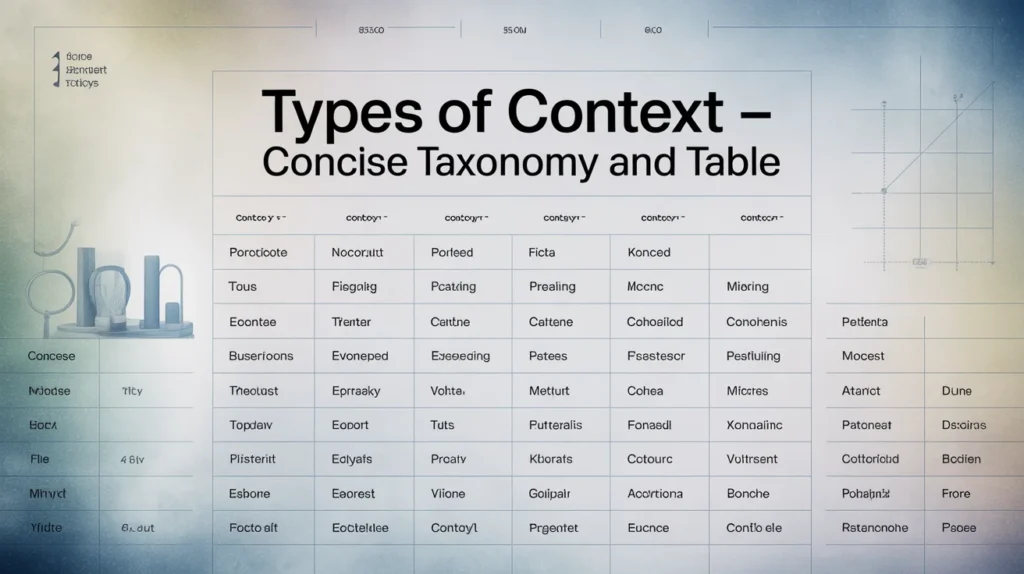
Different projects need different context types.
Below is a compact table and short notes on each type.
| Type | What it captures | Example signals | Typical application |
| Linguistic | Nearby discourse and speaker intent | Previous sentences, tone labels | NLP, chatbots |
| Situational | Immediate task and physical state | Location, device, time | UX, IoT |
| Social | Roles and relationships between actors | Job title, social group | Messaging, legal |
| Cultural | Shared norms and values | Language idioms, taboos | Marketing, localization |
| Temporal | Time-based constraints and recency | Timestamps, seasonality | Forecasting, alerts |
| Spatial | Geographic and physical layout | GPS, floorplan | AR, robotics |
| Technical | Platform, API versions, capabilities | Browser, SDK version | Engineering, deployment |
| Interactional | Dialogue turn-taking and intent | Speaker turn, formality | Conversational UI |
Notes
- Types overlap naturally; many projects use several types together.
Treat them as lenses, not rigid buckets. - Prioritize the types that change outcomes most in tests.
How to define context for yourprojectsix-step process
A repeatable process keeps teams focused.
Follow these six steps and document results.
Six-step process
- Clarify the decision points the system must make.
- List actors and stakeholders who influence those decisions.
- Map candidate contextual dimensions and their rank.
- Choose observable signals and reliable data sources.
- Build a minimal representation and validate it with tests.
- Iterate based on drift, new use cases, and audits.
Checklist teams can copy
- Decision points listed with acceptance criteria.
- Stakeholder map with responsibilities and owners.
Ranked dimensions with rationale. - Signal inventory with source, update frequency, and quality notes.
- Validation plan and KPIs.
- Governance notes for privacy and retention.
Suggested deliverables per step
- Step 1: Decision matrix and sample scenarios.
- Step 2: Stakeholder RACI and contact points.
- Step 3: Context dimension spreadsheet.
- Step 4: Data flow diagram and ingestion spec.
- Step 5: Test harness and evaluation scripts.
- Step 6: Versioning plan and change log.
Methods to capture and analyze context — pros and cons
Capturing context requires method choices.
Each method trades nuance for scale differently.
Qualitative methods
- Interviews, contextual inquiry, and field observation.
- Strengths: deep nuance, hidden signals emerge.
- Weaknesses: limited scale, researcher bias risk.
Quantitative methods
- Telemetry, logs, and sensor streams.
- Strengths: scale and repeatability.
- Weaknesses: noisy signals and missing semantics.
Computational approaches
- Knowledge graphs, probabilistic models, and embeddings.
- Strengths: automation and inference across sparse signals.
- Weaknesses: model assumptions and explainability gaps.
Hybrid approach
- Combine qualitative exploration with quantitative validation.
- Use human-in-the-loop for edge cases and model correction.
- Hybrid often yields best balance between nuance and scale.
Decision rules to pick methods
- If nuance matters choose qualitative first then scale.
- If latency matters prefer lightweight telemetry and rules.
- If complexity grows pick graph models with governance.
Modeling and representing contextpractical options and examples
Representation choices affect reuse, observability, and performance.
Choose formats that match scale and complexity.
Common representations
- Context bag (key-value): simple, easy to store.
- Feature vectors: ready for ML pipelines.
- Ontologies / RDF: interoperability across systems.
- Knowledge graphs: rich relationships and inference.
Practical selection rules
- For single-service features use key-value bags.
- For ML features use normalized vectors and schemas.
- For cross-team metadata adopt JSON-LD or RDF.
- For complex semantics prefer knowledge graphs.
Rules for representation
- Keep representations compact and versioned.
- Name fields consistently across services.
- Include provenance metadata for auditing.
- Avoid mixing raw PII without governance markers.
Use cases with measurable outcomes
Concrete use cases show context value.
Each example includes problem, context dimensions, approach, and metrics.
NLP disambiguation
- Problem: ambiguous user utterances cause wrong actions.
- Dimensions: linguistic, interactional, temporal.
- Approach: add discourse window and speaker intent features.
- Key metric: intent accuracy and misclassification drop.
Personalized UX
- Problem: generic content reduces engagement.
- Dimensions: situational, temporal, device.
- Approach: runtime content selection rules and light-weight model.
- Key metrics: click-through rate and session duration.
Clinical decision support
- Problem: alerts fire without patient context.
- Dimensions: temporal, medical history, social.
- Approach: integrate longitudinal patient context and rule backstops.
- Key metrics: false-alert reduction and clinician override rate.
IoT smart home automation
- Problem: devices trigger at wrong times.
- Dimensions: spatial, temporal, occupant presence.
- Approach: fuse motion, calendar, and location signals.
- Key metrics: false-trigger rate and manual correction count.
Alternatives and related conceptswhen to choose less
Sometimes full context modeling adds cost without value.
Understand alternatives and when they suffice.
Related terms and quick definitions
- Background: passive knowledge assumed but not observed.
- Metadata: descriptive labels tied to resources.
- Frame: a cognitive or problem-solving lens.
- Scope: boundary of relevance for a decision.
- Situational awareness: real-time perception and comprehension.
When to use alternatives
- Use metadata for cataloging and search.
- Use scope to avoid modeling irrelevant signals.
- Use frame for problem-specific heuristics.
- Use full context when outcome changes significantly with signals.
Comparison table
| Concept | Ease to implement | When to pick |
| Metadata | Easy | Indexing and discovery |
| Frame | Easy to moderate | Single-use heuristics |
| Scope | Easy | Limit analysis cost |
| Context | Moderate to hard | Safety or personalization needs |
Common challenges and pitfall mitigations

Defining context creates predictable challenges.
Plan mitigations early and document trade-offs.
Ambiguity and underspecification
- Problem: teams assume different meanings.
- Mitigation: force explicit examples and decision tables.
Temporal drift
- Problem: signal distributions change over time.
- Mitigation: add retraining schedules and freshness checks.
Privacy and consent
- Problem: context often contains sensitive data.
- Mitigation: minimize collection and adopt differential retention.
Bias in signals
- Problem: inputs reflect social bias and skew outcomes.
- Mitigation: run bias audits and counterfactual tests.
Cost and complexity
- Problem: excessive signals increase maintenance.
- Mitigation: prioritize by causal impact and test incremental gains.
Quick mitigation checklist
- Document assumptions and sample scenarios.
- Run small-scale pilots before full rollout.
- Add monitoring and alerting for drift.
- Include human review hooks for edge cases.
- Version context schemas and data sources.
Best practices and templates you can copy
Concrete templates speed implementation and align teams.
Below are ready-to-use artifacts.
Context-definition template
- Name: short label for the context.
- Scope: decision points covered.
- Actors: roles and identities involved.
- Dimensions: ranked list of context types.
- Signals: names, sources, formats, frequencies.
- Owner: team and contact.
- Retention: how long to keep signals.
- Privacy: consent and PII handling.
- Validation: tests and KPIs.
Measurement plan skeleton
- Primary KPI: single number to track.
- Secondary KPIs: two or three supporting metrics.
- Baseline: current metric values.
- Target: realistic improvement goal.
- Evaluation cadence: weekly, monthly, or quarterly.
Validation protocol example
- Prepare held-out scenarios for edge cases.
- Run A/B or counterfactual experiments.
- Record manual review outcomes and error categories.
- Iterate until KPI target met and variance reduced.
Governance brief sample
- Define access controls and encryption for context stores.
- Maintain audit logs for context changes.
- Publish a minimal privacy notice for users.
- Schedule periodic reviews for retained signals.
Tools, libraries, and standards to consider
Choose tools that match scale and interoperability needs.
Below are pragmatic recommendations with purpose notes.
NLP and ML
- Use industrial NLP toolkits for fast prototyping.
- Consider model hubs for pre-trained components and transfer learning.
Knowledge representation
- Adopt JSON-LD or schema.org for cross-system metadata.
- Use RDF or OWL when formal semantics are required.
Observability and telemetry
- Instrument events with consistent naming and timestamps.
- Store provenance to trace signal origins.
Graph stores and inference engines
- Use graph databases when relationships matter.
- Keep graph schemas small to reduce complexity.
Selection guidance
- Prefer simple tools for single-service contexts.
- Pick interoperable standards for multi-team projects.
- Automate where error cost is high.
Short case studies — concise and replicable

Three short, repeatable case studies are included.
Each shows approach, signals, outcomes, and lessons.
Case study — customer-support assistant
- Problem: bot misroutes technical questions often.
- Signals used: user role, recent product page visited, last support topic.
- Approach: add 30-second discourse window and role tag.
- Outcome: routing accuracy improved and escalations dropped.
- Lesson: small context windows fix many ambiguity errors.
Case study — medication reminder service
- Problem: reminders fire at unsuitable times.
- Signals used: user calendar, sleep hours, timezone.
- Approach: fuse calendar and declared sleep schedule for timing.
- Outcome: adherence rose and user complaints fell.
- Lesson: aligning reminders to personal routines matters.
Case study — smart office energy optimization
- Problem: HVAC runs in unused spaces.
- Signals used: occupancy sensors, meeting schedules, room type.
- Approach: apply lightweight rules with occupancy thresholds.
- Outcome: energy consumption fell and comfort stayed stable.
- Lesson: simple rules plus correct signals solve many problems.
Quick reference cheat sheet — printable essentials
A one-page cheat sheet helps practitioners move fast.
Use this as an operational quick reference.
One-line decision tree
- Does a signal change a decision? If yes, collect it.
- If no, treat the signal as metadata.
Top three validation checks
- Reproducibility on held-out scenarios.
- Drift detection within two weeks.
- Human review coverage for low confidence cases.
Mini glossary
- Signal: raw observable datum.
- Dimension: category grouping signals.
- Snapshot: captured context at a moment.
- Provenance: origin metadata for a signal.
Conclusion and pragmatic next steps
Context Definition transforms ambiguous systems into reliable ones.
Start small and measure impact before expanding scope.
Prioritize explainability and privacy from the start.
Running controlled pilots yields clear evidence fast.
Three immediate next steps
- Pick one decision that fails currently and document it.
- Create a minimal context-definition template for that decision.
- Run a two-week pilot and measure the primary KPI.
Call to action
Adopt a context-first mindset and validate with data.
The right context reduces surprises and improves outcomes.
Appendix
Further reading and canonical references
- Look for applied work in human-computer interaction and contextual computing.
- Search for recent engineering patterns in knowledge graphs and privacy-preserving telemetry.
Downloadable templates
- Use the context-definition template and measurement plan provided above.
- Keep copies versioned in your project repository.
Glossary of essential terms
- Context snapshot: a captured set of signals at a time.
- Feature vector: numeric encoding of signals for models.
- Ontological schema: formal description of entity types and relations.
“Context turns noise into signal and guesswork into design.”
Table: Quick checklist for immediate use
| Action | Why it matters | Time to implement |
| Define decision points | Focuses scope and saves effort | 1 day |
| Inventory available signals | Reveals data gaps and cost | 2 days |
| Build minimal snapshot format | Enables consistent capture | 2 days |
| Run pilot with KPIs | Proves impact with evidence | 2–4 weeks |
| Add governance notes | Prevents privacy and bias issues | 1 day |
This guide contains practical steps, copy-ready templates, and replicable case studies.
Use the templates and checklists to define context for your project.
Measure early, iterate often, and govern transparently to capture lasting value.

Founder of PunnyPeeks and master of celebration magic, David Mass is the creative spark behind the brand’s bold, balloon-filled brilliance. With an eye for color, a flair for design, and a passion for making people smile, David transforms events into unforgettable experiences. From quirky puns to perfectly curated party decor, he believes that every occasion deserves a splash of fun and a whole lot of heart.